
When a genome is incomplete
Source:vignettes/articles/incomplete-genomes.Rmd
incomplete-genomes.RmdWhat does an incomplete genome do to a GIFT call? We removed genes from complete reference genomes, then evaluated the remaining evidence at each level. Complete calls disappear as their required steps lose support. The closest incomplete route still names what is missing, while genome quality changes only whether an unsupported call can count as an informative absence.
These experiments used database 2026.27.1. The live catalogue has since changed; the numbers below describe the pinned analysis, not a prediction for the current database.
In short
- A complete route call falls faster under gene loss than a flat marker fraction, because losing one required reaction loses the call.
- Most lost calls are exactly one reaction short. They remain unsupported, but identify the chemistry to check in the assembly or annotation.
- The completeness policy withholds uninformative absences from
denominators. It never restores a lost call. When no member is
assessable, it emits no
supported_fraction. - Co-occurrence of neighboring genes did not justify filling missing steps.
What disappears when genes disappear
The analysis sampled 120 KEGG reference genomes across the curated-marker-count distribution. For each genome, it retained 90%, 80%, 70%, 60% or 50% of its genes in three independent subsamples, then evaluated the GIFTs again. Genes were removed, and their markers followed. This preserves the fact that several markers on one gene vanish together.
The comparator is the fraction of each GIFT’s curated KO markers still present in the same subsamples. It is a flat marker-fraction baseline, not native KEGG MODULE evaluation, which also represents alternatives and complexes.
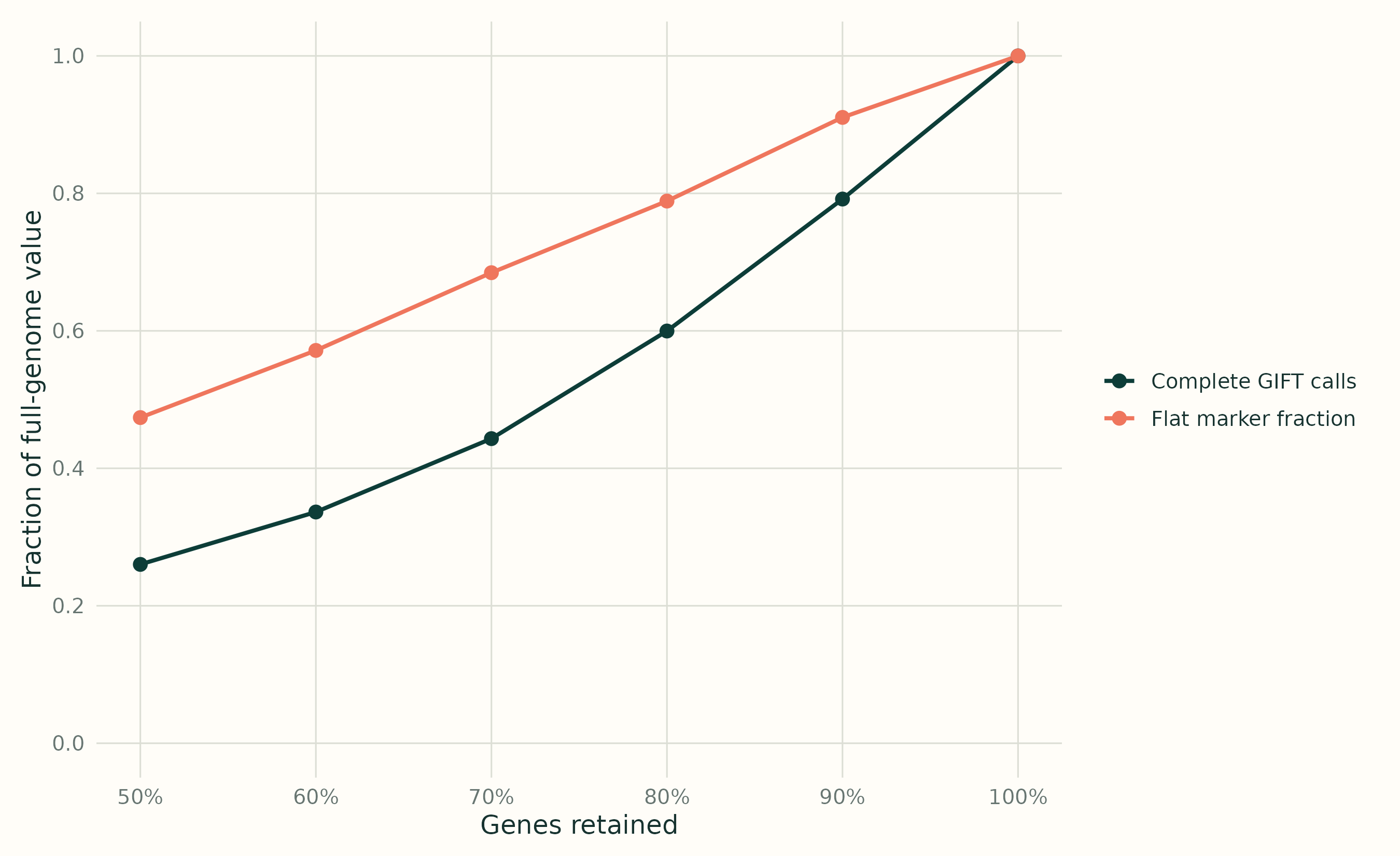
Mean retained complete GIFT calls and mean flat marker-fraction score, each relative to its full-genome value on the same 120 genomes. The flat score is not KEGG MODULE completeness.
At 90% gene content, 0.792 of the original complete calls remain, while the marker-fraction score retains 0.911 of its full-genome value. At 50%, the values are 0.260 and 0.474. A call is lost when a required reaction loses its final accepted marker; a fraction can decline gradually. No subsample gained a GIFT that the full gene set did not support.
A lost call still names its gap
Across the subsamples, 42,636 formerly complete calls were lost. 28,524 of them, or 66.9%, lacked exactly one reaction in their closest route. At 90% gene content, the share was 83.7%.
An unsupported call reports minimum_missing_requirements
and its closest implementation. For a metabolic GIFT,
missing_reactions_best_route names the reaction to
investigate. The single-genome
guide shows how to read that trace. A near miss is a curation or
annotation lead; it does not establish that the organism encodes the
missing step.
Quality changes a denominator, not a call
The same subsamples were read within three bounded anabolic frames at
a threshold = 0.9. Below the threshold,
policy = "completeness" treats every unsupported member as
indeterminate for denominator calculations. In the 3,823 below-threshold
cases where supported_fraction could still be reported, it
was 1.000 every time: only supported members remained assessable. In
another 497 cases, no member was assessable and the
supported_fraction row was absent, rather
than zero or NA.
Read supported_fraction alongside
assessable_fraction and the supported count. The latter
never changes under the policy. The quantitative-traits
tutorial shows how to request and interpret those metrics for a
MAG.
Why neighboring evidence does not fill a gap
A second analysis asked whether a missing component or requirement could be inferred from the others commonly found beside it. In the reference panel, 718 contexts had enough genomes for that screen. After controls for genus and background prevalence, 43 appeared strong enough under an independent-gene-loss assumption. Removing contiguous runs of neighboring genes, closer to how assemblies lose contigs, left 2 candidates at a mean run of 20 genes and 2 at 50 genes; those candidates were not the same. Co-occurrence therefore provides no reliable rule for changing an unsupported GIFT to supported.
Random gene deletion does not reproduce all assembly biases, and the experiment kept the original gene calls fixed. Its retention curve describes a controlled sensitivity analysis, not a calibration of real MAG completeness. The contiguous-run analysis addresses gene linkage for the gap-filling question, not every bias in an assembled genome.
Reproduce this analysis
The figures and values here read the committed R7
tables. The producing scripts are 02-incompleteness.R,
09-cooccurrence.R
and 10-block-drop.R.
The manuscript
account gives the full methods, controls and interpretation.